
SUPPORT
IASUS Concepts FAQ – Throat Mics, Helmet Audio & Advanced Communication
For help with setup, compatibility, hearing safety, and advanced communication systems, browse the sections below.
If you’re experiencing technical issues, we also recommend reviewing our Troubleshooting Page for step-by-step solutions.
Getting Started with IASUS Throat Microphones
How do I set up my IASUS Throat mic?
Plug the throat mic into the M2 adapter, ensuring the male and female pins are properly aligned. Do not force the connection.
Place the neckband around your neck and position the transponder so it sits flush against your skin.
If using a PTT (Push-To-Talk), press the button to transmit and release to receive.
Adjust the throat strap and test repeatedly until you find your personal “sweet spot.”
Most users find the optimal position to be ½ to 1 inch from the center of the throat, balancing clarity and volume. Placement varies depending on anatomy, voice characteristics, and facial hair. Moving the transponder closer to the voice box increases volume but may introduce distortion.
For VOX mode, ensure your radio or phone supports VOX and is correctly configured. Some setups require a straight VOX adapter, please contact IASUS for guidance.
Troubleshooting & Warranty Support
My IASUS product is not working. What should I do?
Visit our Troubleshooting Page for solutions to common issues.
If your question is still unresolved, contact your authorized reseller or submit a request through our customer inquiry form.
What is the IASUS one-year limited warranty?
All IASUS throat mic systems include a One-Year Limited Warranty. To qualify:
Purchase must be made through an authorized IASUS reseller
- Product must be registered within 1 month of purchase
- Original proof of purchase must be retained
- Full details are available on our Warranty Registration Page.
See our Warranty Registration page for complete details.
Choosing the Right IASUS Throat Mic
Which throat mic is right for me?
IASUS Concepts offers a range of professional-grade throat microphone systems, each engineered for specific communication environments and operational needs. With over two decades of throat mic innovation, IASUS products are designed to deliver reliable voice transmission in high-noise, wind-intensive, and mission-critical environments.
Current IASUS Throat Microphone Systems
NT5 Wired Throat Microphone
The NT5 is IASUS’ latest-generation wired throat microphone, featuring advanced Noise Terminator technology, improved transponder sensitivity, refined ergonomics, and expanded compatibility with professional radios, mobile devices, and custom communication systems. It is ideal for users requiring maximum reliability, clarity, and durability in demanding conditions.Stealth Wireless Throat Microphone
The IASUS Stealth is the world’s first professional-grade modular wireless throat microphone system. Designed for extreme wind and background noise environments, the Stealth offers Bluetooth connectivity, a fully modular architecture, and professional audio performance—making it ideal for tactical, industrial, motorsports, and advanced communication applications.BMT Wireless Throat Microphone
The BMT throat microphone utilizes Bluetooth 5.2 technology and features IASUS Variable Transparency Mode (VTM), allowing users to hear their surroundings when needed. This makes the BMT an excellent choice for users who require wireless communication while maintaining situational awareness in dynamic environments.
Modular by Design, Built to Adapt
All current IASUS throat microphone systems are modular and customizable, allowing users to configure earpieces, helmet audio, PTT options, adapters, and wireless accessories to suit their specific application. Whether you need a hard-wired solution or a fully wireless system, IASUS throat mics are engineered to scale with your communication requirements.
| Transponder | Earpiece | Accessories | Popular Applications | Special Features |
|---|---|---|---|---|
| Gen 3.0 NT Transponder, aluminum (NT3-R) | Acoustic Coil, clear | Finger PTT, contour earpieces (clear), additional adaptors | Recreational, professional multi-applications | Flexible throat strap, braided cables, acoustic coil, magnetic break-away clasp, multi-adaptor options |
| Gen 3.0 NT Transponder, black (NT3-R BK2) | Acoustic Coil, black | Sniper MOLLE-spec Magnesium PTT, Finger PTT, contour earpieces (black), additional adaptors | Recreational and professional tactical | Reinforced flexible throat strap, braided cables, black acoustic coil, magnetic break-away clasp, multi-adaptor options, comes with magnesium Sniper PTT and Finger PTT (except for PC and phone versions) |
| Gen 3.0 GP Transponder, aluminum (GP3-R) | Xsound Helmet Speakers (removable, can be replaced with any mono or stereo 3.5mm headphones) | Finger PTT | Motorcycles, scooters, snowmobiling, extreme sports, racing, cycling | Flexible throat strap, braided cables, high-fidelity helmet audio, magnetic break-away clasp, multi-adaptor options, comes with Finger PTT (except PC and phone versions) |
Purchasing & Availability
Where can I buy IASUS products?
IASUS products are available through the IASUS Concepts Official Store and authorized resellers worldwide.
To locate a dealer in your region, contact [email protected]
If you’re interested in becoming a reseller, email [email protected]
Compatibility with Phones, Radios & Devices
Are IASUS products compatible with my phone, radio, or device?
IASUS throat mics are compatible with:
- Most mobile phones (USB-C, 2.5mm and 3.5mm jacks)
- PCs and select gaming consoles
- A wide range of professional and recreational two-way radios
Please consult our compatibility table for specific device support.
For best results, pair IASUS headsets with higher-powered UHF radios, as lower-end radios may not meet performance requirements. IASUS also offers the DualComm Radio, designed for full compatibility with our headsets.
Durability, Waterproofing & Product Care
Are IASUS products waterproof or water-resistant?
- Magnesium Sniper Pro PTT switches and premium XSound volume cables are waterproof
XSound Helmet Speakers and DualComm radios are water-resistant.
All main throat mic components are water-resistant.
How durable are IASUS throat microphones?
IASUS Noise Terminator throat mics are engineered using premium materials for durability and reliability.
Because the transponder must remain highly sensitive to vibrations, it should be handled with care to avoid impact damage.
Returns & Customization
What is your return policy?
Return policies are determined by the reseller and are available through the IASUS Official Online Store.
Can I customize an IASUS throat mic system?
Yes. The NT5, NT3-R, GP3-R, and Black Ops 2 systems support expanded customization options.
For specialized requirements, IASUS offers custom-built communication systems. Contact [email protected]
for details.
Wireless, Bluetooth & Advanced Communication
Does IASUS offer Bluetooth throat mics?
Yes. The IASUS Stealth Bluetooth Throat Mic is the world’s first professional-grade wireless modular throat mic system, designed for extreme noise environments.
IASUS also offers the BMT Bluetooth Throat Mic, featuring Bluetooth 5.2 and situational awareness capabilities.
For helmet communication, the REKON and BMH systems provide integrated Bluetooth communication for motorcycles and helmet-required sports.
Hearing Safety & Best Practices
Is it safe to use a single-ear earpiece?
In loud environments, users must wear an earplug in the opposite ear. Without protection, the brain compensates by increasing volume levels, which may cause hearing damage.
Earplugs are also recommended when using GP3-R helmet speakers during riding.
Will IASUS throat mics pick up whispered communication?
Yes. IASUS throat mics can transmit whispers when paired with professional-grade radios.
Recreational radios may lack sufficient transmission power. Whispering may not reliably activate VOX mode.
How Throat Microphone Technology Works
How does IASUS throat mic technology differ from boom mics?
Traditional microphones capture airborne sound.
IASUS throat mics capture laryngeal vibrations directly, allowing communication without interference from wind or background noise.
IASUS uses a single-transponder design, positioned slightly off-center on the throat to avoid distortion caused by asymmetrical neck anatomy.
What are the applications of throat mic technology?
Originally developed for WWII pilots and tank crews, throat mic technology is now widely used in:
- First Responder and safety operations
- Motorcycling and motorsports
- Extreme sports and helmeted activities
- Professional security and industrial environments
Learn more on our History of the Throat Mic and About Throat Mics pages.
Helmet Speakers & Audio Optimization
How do I properly install XSound helmet speakers?
For best performance, helmet speakers must sit flush against your ears.
Use foam spacing pads to achieve proper positioning.
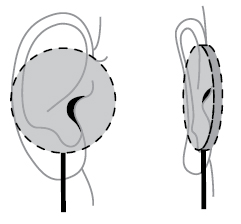
Test speakers directly with your smartphone before installation to confirm sound quality and placement.
- Speakers must contact your ears inside the helmet.
- Use included foam pads to optimize positioning.
- Mount speakers slightly forward/lower for proper ear alignment.
- Test speakers with a phone or music player before final installation.
Failure to do the above may cause damage to the speakers – the main cause being the volume gets turned up past acceptable levels to compensate for any wind and engine noise introduced by any gaps.
Before mounting the speakers in your helmet
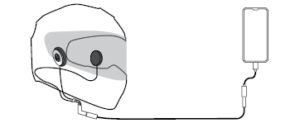
It is recommended to test and connect the helmet speakers directly to your smartphone or music player first using the 3.5mm cable and holding them to your ears as your music plays to confirm the optimal position before mounting them in your helmet.
My helmet speakers fit too tightly.
Certain brands of helmet and headgear are designed for a tighter fit and may not accommodate our speakers. Please determine whether your helmet can comfortably accommodate the extra 1/2 inch of helmet speaker on each side before your purchase.
Are my XSound speaker cables faulty?
Due to RoHS compliance, all modern audio cables are biodegradable and may degrade over time. This applies to all manufacturers, including premium brands.
Music crackles or pops when used with a motorcycle comm system headset or Bluetooth receiver. Are they defective?
Try connecting the helmet speaker directly into a smartphone or music player and play at the same volume. If the crackling or popping disappears, your motorcycle helmet audio headset or Bluetooth receiver is likely the cause. They tend to not support low-frequency outputs because typically their stock speakers do not deliver audio in that range.
While our XSound series of helmet speakers are designed and tested to be able to play at max volume on smartphones and music players without distortion, IASUS does not recommend listening to music at excessive levels which may lead to temporary or permanent hearing damage. Please proceed with caution.
As the XSound’s quality makes them the ideal choice to replace the stock speakers which motorcycle headsets come with, we are unable to confirm the compatibility with every model of motorcycle headsets (and Bluetooth receivers) out on the market.
The audio plays at a low volume or with lots of treble and lack bass.
Please use the foam pads to position the speakers so they sit flush against your ears the same way you held them on your ears before installing them in your helmet.
The helmet speaker/ear adjustment tab.
Please use the foam pads to position the speakers so they sit flush against your ears the same way you held them on your ears before installing them in your helmet.
For tight fitting helmet enclosures, volume level and sound quality of your XSound helmet speakers may be diminished if the ears get folded after putting on your helmet. When this happens, the audio does not have a direct path to your ears, hence the reduced volume and poor sound quality. Since it is difficult to access your ears due to the tight fit of your helmet, we included a Tab that was specifically to reach that are through either the space from your visor (when opened) or from the bottom of your helmet. The thin tab should be able to reach and be able to position your ears correctly. Also note that to optimize the sound quality of the Xsound helmet speakers, the speakers need to sit flush and directly on the ears. Sometimes, pending how you pivot the helmet the ear cavities are not aligned properly with your ears and that may also affect your audio experience. In order to benchmark the audio, we recommend that you listen to the helmet speakers on your ears directly prior to installation to have a feel for the sound and volume levels.
The Xsound Helmet Speaker (Xsound 4) package also includes a key ring for the Helmet Speaker Tab so that it can conveniently double as a great motorcycle key holder. This way you won’t forget to bring it or loose it when you are riding.
Amplifiers, PTTs & Accessories
Issues connecting the Zello Bluetooth button to a new phone.
The PTT must be removed/disconnected from the Zello PTT app or ESChat app on your old phone first before you can pair it to the new phone.
I don’t have access to the old phone anymore.
If you are having issues with pairing the BLE PTT in Zello, log into Zello on your computer at https://my.zello.com/personal/account-sign-in/ and change your password. Log into the account on your new phone and connect the BLE PTT.
EAR3H & EAR3H-MK2 battery care
IMPORTANT
Be sure to TURN OFF your EAR3H Helmet Amplifier after each use and keep it charged when being stored!
If you leave the EAR3H Motorcycle Headphone Amplifier on and forget to turn it off after use for prolong period of time, there will be damage to the battery.
Keep in dry cool place when not in use.
Earmold Care & Cleaning
How do I clean and disinfect earmolds?
Cleaning.
Cleaning earmolds involve simply removing gross contamination from the device’s surface area. No germs are removed during the cleaning process. Common materials and tools employed to clean earmolds are dry tissues, dry paper towels, cleaning brushes, and wire loops.
Disinfecting an earmold, all contamination and germs are removed from the device. The materials used to disinfect an earmold usually consist of moist non-alcohol based disinfectant surface wipes, or a spray of the same type of solution.
Care.
Place an earmold on surfaces where bacteria and fungi proliferate, i.e. counter tops, desks, purses, pockets, etc.
Store an earmold in a container that cannot be washed out with soap and water, such as a jewelry box, small cardboard box, or paper envelope.
Allow people to handle an earmold if they do not understand how to disinfect it after they have touched it.
DO
Store earmolds in washable containers (plastic).
Clean and disinfect earmolds every day, or at least when they are worn.
Do you want to know more about our technology?
When will IASUS Concepts develop a Bluetooth compatible headset?
The IASUS Stealth Bluetooth Throat Mic represents over a decade of throat mic development, now available for purchase as the world’s first professional wireless throat mic modular headset system. Designed for extreme wind or background noise communication applications, the Stealth is fully modular, offering a versatile solution for various communication needs. Contact us with your requirements, and we’ll help find the right solution for you.
Additionally, the BMT throat mic is another Bluetooth option, utilizing Bluetooth 5.2 technology. This version includes a situational awareness feature, allowing users to hear their surroundings when necessary, ensuring safety and adaptability in various environments.
For helmet communication, IASUS also offers the Rekon and BMH products, which are ideal for motorcycle comm systems, motorcycle intercoms, snowmobiling, snowboarding, skiing, and other helmet-required activities.
Is there any risk to my hearing using a single-ear earpiece device?
In particularly noisy environments such as concerts and clubs, pairing your throat mic’s single-earpiece with an earplug in the opposite ear is a MUST. This is because in order to register sound, the brain processes the dominant sound level from either the left or right ear. That means that when using the NT3R or Sniper Pro 2 in a loud environment, the volume of the audio source needs to be louder than the external noise in order for your brain to “hear,” resulting in potential loss of hearing in high volume situations. Earplugs are also recommended for use in conjunction with the GP3-R stereo helmet speakers while riding.
Will the transponder pick up whispered communications?
IASUS Noise Terminator throat microphones WILL pick up whispers, but their transmission quality depends on the quality of your radio. Recreational radio transmissions are generally not powerful enough. We suggest using a high-power professional grade radio and turning up the volume on it to successfully transmit whispers. Please keep in mind that in VOX mode, whispers might not be enough to trigger the transmission function.
How does throat microphone technology work?
IASUS Noise Terminator Throat Mics are different from conventional headset communication systems. Traditional boom microphone systems are based on acoustic induction from sound waves in the air. By contrast, IASUS Throat Microphones pick up voice signals via vibrations generated by the user’s larynx through a transponder that rests on just off the center of the throat. This way, our throat mic systems “eliminate” background noises by simply not picking them up, making the NT3-R ideal for use in noisy environments and in situations where quiet, covert communication is necessary.
Some throat mics use a double-transponder design in which each transponder rests on either side of the throat. This is not ideal, because most people do not have perfectly symmetrical necks, which leads to an imbalance of the transmission wavelengths from each transponder and causes distortion. IASUS has engineered the NT3-R with a single transponder that hits the “sweet spot” about 1 to 2 inches from the center of your throat.
What are the applications of the throat technology?
Throat microphones were first used by tank crews and military pilots in WWII whose helmets and breathing apparatus made conventional microphones impossible to use. The technology has since advanced, improved, and expanded in its popularity and use. For more information, visit History of the Throat Mic and About Throat Mics on our About Us section.