Action Camera Audio in Extreme Conditions: Why Standard Microphones Fail (and How Throat Mics Solve It)
The Problem Most Riders Don’t Realize Until It’s Too Late
Action cameras have improved dramatically in video quality, stabilization, and usability. But audio is still where most setups break down, especially in real riding conditions.
At low speeds or in controlled environments, most microphones perform reasonably well. The problem begins when conditions change:
- Highway speeds
- Strong wind exposure
- Helmet turbulence
- Off-road riding
- Cold-weather gear noise
- High vibration environments
This is where recorded audio often becomes unusable, either heavily distorted or completely dominated by wind noise.
The result is simple:
Great footage but unusable sound.
Why Action Camera Microphones Struggle in Real Riding Conditions
Most action camera audio systems rely on air-captured sound, including built-in microphones or external boom and lavalier microphones.
The limitation is physical rather than software-based.
1. Wind Noise Overwhelms Voice Capture
At speed, wind becomes a constant high-pressure airflow hitting the microphone diaphragm. This produces:
- Low-frequency rumble
- Audio clipping
- Complete voice masking
Even with digital wind reduction, the microphone is still physically overwhelmed at the source.
2. Helmet Acoustics Distort Sound
Inside a helmet, sound behaves unpredictably:
- Reflections off hard surfaces
- Compression from padding
- Channeling through vents
- Vibration from the helmet shell
This creates inconsistent voice capture depending on speed and head position.
3. Distance Between Mouth and Microphone Matters
Boom microphones rely on proximity, but that distance becomes a weakness at high speed.
A few centimeters of movement caused by wind or helmet shift can drastically change:
- Volume
- Clarity
- Noise exposure
Why Software Noise Reduction Is Not the Real Fix
Many systems attempt to solve the problem after capture using:
- AI noise suppression
- Wind filters
- Audio normalization
But this approach has a limitation:
You cannot fully restore audio that was never cleanly captured in the first place.
Once wind distortion saturates the signal, detail is permanently lost.
The Fundamental Shift: Capturing Voice Differently
Instead of trying to filter out environmental noise, throat microphone systems approach the problem differently.
They reduce dependence on air-captured sound.
This is where throat microphone technology changes the equation.
How Throat Microphones Work in Real Riding Conditions
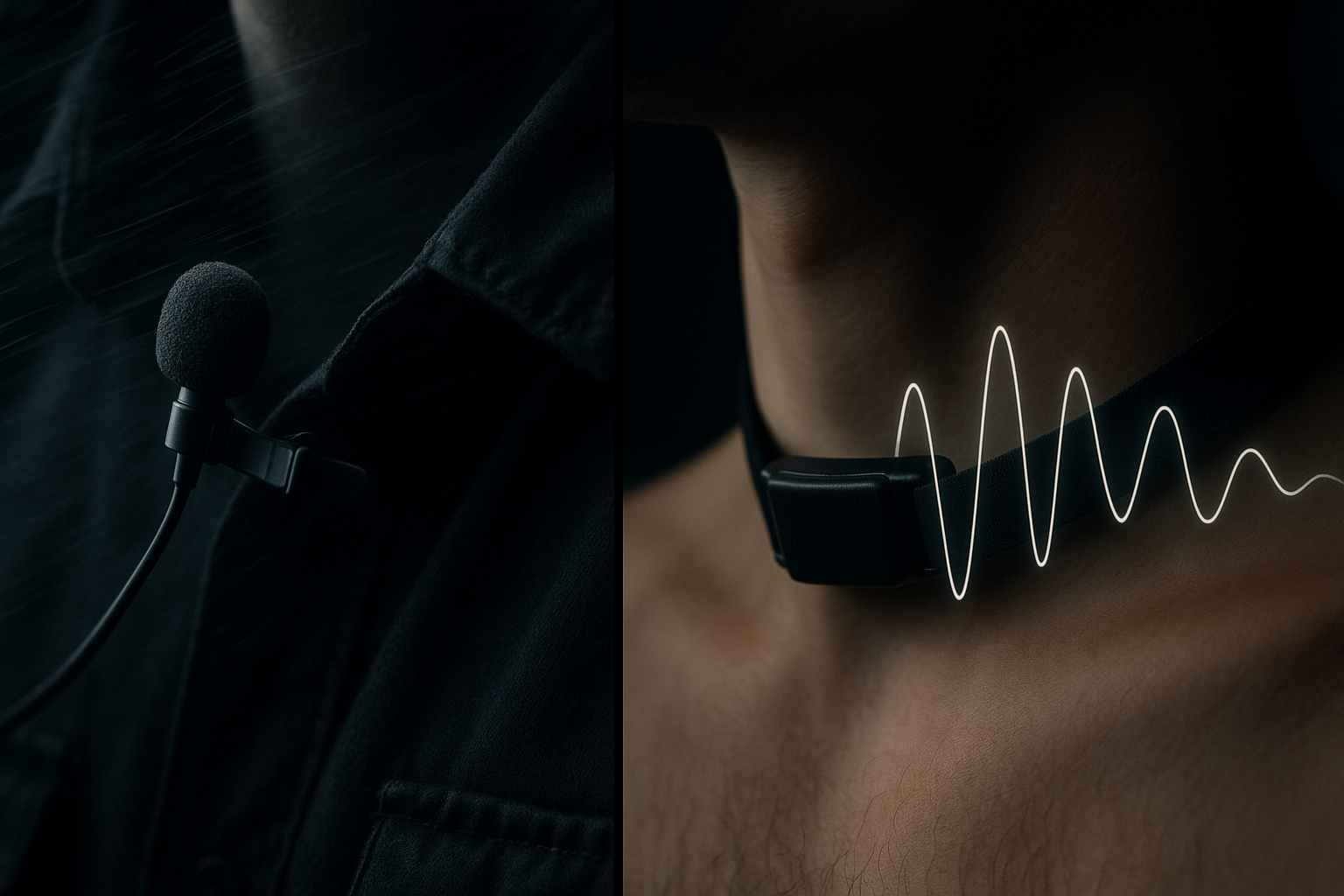
Unlike traditional microphones, a throat microphone does not rely on picking up sound waves through air.
Instead, it captures vibrations directly from the vocal cords through skin contact.
This means:
- Wind has minimal effect
- Engine noise is largely irrelevant
- Helmet acoustics become less important
- Voice signal remains stable at all speeds
The result is a signal that originates from the source of speech itself, rather than the environment around it.
What This Means for Action Camera Audio
When paired with an action camera system, a throat microphone changes the audio outcome significantly:
- Consistent voice clarity at all speeds
- Dramatically reduced wind interference
- Stable audio levels during movement
- Reliable recording in extreme environments
This is especially useful for:
- Motorcycle riders
- Off-road riders
- Snowmobile users
- Industrial or tactical environments
- High-speed content creation
When a Throat Mic Makes the Most Sense
Throat microphone systems are not necessarily a replacement for all audio setups. They are purpose-built for specific conditions.
They are most effective when:
- Wind noise is a constant issue
- Helmet-based microphones fail to isolate voice
- Audio consistency is more important than natural tone
- Riding speed regularly exceeds moderate levels
- Environmental noise cannot be controlled
Where IASUS BMT Fits Into This
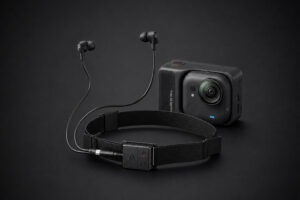
The IASUS BMT system is designed specifically around this principle of vibration-based voice capture.
Instead of relying on air movement, it is engineered for stable communication in environments where traditional microphones struggle.
It is commonly used in:
- Motorcycle communication setups
- Action camera recording environments
- High-noise industrial conditions
- Extreme weather riding scenarios
Throat Mic vs Traditional Helmet Microphones
| Condition | Traditional Boom Mic | Throat Mic (BMT) |
|---|---|---|
| Low-speed riding | Excellent | Good |
| Highway riding | Inconsistent | Stable |
| Heavy wind | Weak | Strong |
| Off-road vibration | Inconsistent | Stable |
| Voice naturalness | High | Moderate |
| Noise isolation | Limited | High |
The Real Tradeoff
Throat microphones are not about sounding better in a studio sense.
They are about maintaining intelligible and consistent communication when conditions would normally destroy audio quality.
That is the key distinction.
Final Thoughts
Action cameras capture motion extremely well, but audio still depends on physics rather than software.
In extreme riding conditions, the limiting factor is not the camera, but how the voice is captured in the first place.
Throat microphone systems represent a different approach to that problem. Instead of fighting environmental noise after it enters the microphone, they avoid relying on environmental sound capture altogether.
For riders and creators operating in demanding conditions, this shift can make the difference between unusable audio and reliable communication.
FAQ – Throat Mic (BMT) vs Traditional Boom Microphones
What is the main advantage of the IASUS BMT throat microphone?
The main advantage is consistent voice capture in high-noise and high-wind environments. Since the BMT captures vibrations directly from the throat rather than relying on air-based sound, it significantly reduces wind and ambient noise interference.
Is a throat microphone better than a boom microphone?
It depends on the use case. Boom microphones generally provide more natural voice reproduction in calm environments, while throat microphones provide more stable and reliable audio in extreme conditions such as highway riding, off-road use, or strong wind exposure.
Will the BMT sound like a normal microphone?
Not exactly. Throat microphones typically sound slightly different because they capture vibration instead of air-conducted sound. The tradeoff is reduced environmental noise and improved clarity in difficult conditions.
Can I use the IASUS BMT for motorcycle communication and action camera recording?
Yes. The BMT is designed for both communication and recording use cases. It can be used for phone calls, navigation audio, group communication, and compatible action camera setups that support Bluetooth audio input.
Is the BMT difficult to set up?
No. Setup is straightforward. Pair the device via Bluetooth to your compatible camera or communication system, confirm the connection, and test audio before use. Once paired, most systems will reconnect automatically.
Does wind noise affect throat microphones?
Wind noise has minimal impact on throat microphones compared to boom microphones because the audio signal is captured internally from vocal vibration rather than external air movement.